Monday, 31 August 2015

Nollywood Star: Tonto Dikeh in Traditional Attire During Her Bride Price Payment Ceremony

NIGERIAN movie star and sexy diva, Tonto Dikeh yesterday had her bride price payment and reception ceremony, which took place in her home town in Rumuokwuta Port Harcourt southern Nigeria. She is now officially married to her best friend and lover Oladunni Churchill AKA Mr “X”. She was ecstatic and she looked elegant in her beautiful traditional wedding attire. We can’t wait to witness her traditional and white wedding ceremonies. See more pictures.


Monday, 24 August 2015

Bling! Bling!! Know How You Can Accurately Measure Your Ring Size

Do you even know that ring has sizes? Guy let say you want to get an engagement ring for your proposal or shopping for your wedding ring. If you are about to do these and you are clueless about ring sizes or you are just curious and want to know your size (for references), then the following steps and guidelines will help you to determine your ring size in a flash.
Follow these steps to help you determine your ring size. These are easy steps that you can do on your own.
Items Needed
Ruler, String of rope
1. Cut a thin strip of rope


2. Wrap the rope around your finger. Make sure the rope is below the joint of your finger and close to your knuckle.


3. Mark the spot where the rope meets and measure the distance with your ruler.


4. Compare your result on the ring chart to determine your ring size.
Tips for Using a Ring Chart
·         Measure the finger in the middle of the day and at normal temperature.
·         Consider knuckle sizes.
·         Use a 100 percent scale when printing the chart.
·         Always round up to a larger size if necessary.
·         Try several types of sizers if possible.
 

I hope this is helpful. You can send us your comments and observation, like us on Facebook and google +

Wednesday, 19 August 2015

Almighty Formula to Get That Dream Body and Astonishing Look For Your Wedding

Effective Weight loss for Brides Before The Wedding
As a bride, getting engaged and preparing for wedding in Nigeria is supposed to be one of the happiest moments in your life, but in reality, getting married is often stressful, especially when it comes to your appearance. Forget choosing the reception venue, Asoebi and preparing your guest list. For most women, the number one thing that comes into their mind after engagement is their weight, how to loose more of it – even if they are a healthy size.

I have seen some bride-to-be using extreme tactics, like skipping meals and taking unprescribed diet pills, having liposuction etc, just to look fabulous on her wedding day. These could be harmful one way or the other to your health. Instead, a healthy diet is something to consider. You will not only give your body the nourishment it needs to keep going on the big day, but a painful free experience. So let’s look at some key areas to help make all the difference.

What you eat plays a huge part in how you look. Some experts says about 80% is down to what you eat and just 20% is the exercise you do. Getting into that desired shape you must watch what you eat.
1. A good start is by reducing sugar intake. Food items with high sugar content such as cereals and sauces should be avoided, start paying attention to the labels and see for yourself. Processed food is definitely something else you should reduce or try and cut out completely.
2. Drink a lot of water. Your body needs to be hydrated in order to function properly. Water can also help you improve your skin complexion, make you appear less bloated and aid in digestion. 
3. You should also avoid indulging in late night snacks. Make sure that you stop your intake of food and drinks at least a few hours before you plan to go to bed. This will allow your body to burn off some of the calories, so they cannot remain in your system after you go to sleep, this help to prevent abdominal protrusion
4. Another factor you will have to consider is alcohol. Your consumption of alcohol is prerequisite to gaining undesirable weight.  I know we all like to have a relaxing glass of wine (or three) after work but if you’ve done a deal with your dressmaker and want to stick to the plan then I suggest you lay off the glasses.  Did you know each glass of wine contains around 185 calories.  That’s the equivalent of a slice of chocolate cake and imagine how many calories you will ingest when you take more glasses.

So now you know a word is enough for the wise

image source: trendsurvivor

Monday, 10 August 2015

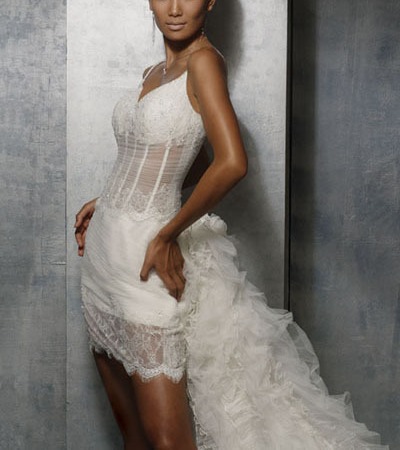
The Connotation and Evolution of Wearing White Wedding Gowns

White wedding dress is obviously the most popular bridal outfit today. If I may ask why is it so? From feed back I got on my questionnaires I posted online, 90% says that white wedding dress stands for purity, therefore the bride is believed to be pure and piety. If that is the case most brides today shouldn’t wear white for their wedding – many of them are morally tainted to wear white for their wedding. Contrary to what most people believe, white wedding dress does not depict virginity or purity but wealth.

Today weddings symbolize love and commitment between the bride and the groom till death do part, these wasn’t the case back then, at the Middle Ages weddings were more like a business deal in which two families joined forces for a beneficial arrangement or alliance. Many weddings were more a matter of politics than love, particularly among the nobility and the higher social classes. Therefore, brides are expected to dress in a manner that speaks well of her family, they represent the family during the ceremony. Brides from wealthy families often wore rich colors like white. White dresses were exclusively for the rich and wealthy because of maintenance. 
In the middle Ages, brides rarely shop for dress specifically for their wedding day. The bride would typically wear her finest dress to the ceremony, even if it was a dark color. In fact, many brides wore black during this time. Only a few colors were avoided, such as green, which was then considered unlucky. Blue was a popular choice as it represented purity, faithfulness and a connection to the Virgin Mary, plus the dark color easily hid stains and imperfections and could be worn again.
How wearing of white wedding gowns started


The origin of white wedding dress can be trace back to Queen Victoria of England; she was the first to wear a white dress for her wedding when she got married her cousin Prince Albert of Saxe-Coburg in 1840. White was not chosen for a wedding dress but blue and other colours, she broke these traditions by wearing a white dress on her wearing day. She was also the first royal bride to have bridesmaids carry her train. Surprisingly, she didn’t wear it to symbolize purity or virginity. She just wore it because, she liked white. 
Decade after the wedding, Godey’s Lady’s Book, with the sentimental statement “ It is an emblem of the purity and innocence of girlhood, and the unsullied heart she now yields to the chosen one,” declared that white was the most fitting color for a bride. This was what inspired the connotations of virginity and purity attached to white wedding dress as we all know today.

Hope you find this educative as much as I do

imageby: cherrymary

Wednesday, 5 August 2015

Wedding Menu: Food to Serve Guest In a Typical Igbo Traditional Wedding

If you are planning to hold a typical Igbo traditional wedding and you don’t have any of this food on your menu then you have to think again. I have listed a few of them here. The Igbo people are socially and culturally unique, blessed with rich and nutritious food. The purpose of this post is to give you an idea of what is expected of you especially in the area of food. This will also help you on menu budgeting for dream Igbo wedding.
Uha soup and cassava ball (fufu): Uha soup (ofe uha) is a delicacy that is present in most Igbo occasions – traditional wedding ceremony, child dedication, house warming, new yam festival, August meeting etc. This soup is more common with the people of Anambra. Uha soup is prepared specially for occasions. Ingredient…. Uha leaf, water, palm oil, seasoning and salt, water pepper, onion, thickener e.g. achi. Crayfish, smoked fish, big stock fish, bush meat, Assorted meat, kpomo etc.

Bitter leaf soup (ofe onugbu):This is also an important dish on the menu of most Igbo occasion – traditional wedding ceremony etc. This soup is eaten with fufu (cassava ball), pounded yam, garri (eba). ofe onugbu. Bitter leaf can also be employ in cooking other soups, some of which are widely eaten across Nigeria – Egusi and bitterleaf soup. The versatility of this leaf cannot be over stretch. This leaf has been found to be medicinal – its speed up metabolism, therefore good for weight loss, it reduces high sugar level.
Ingredient- Cocoyam is use as a thickener and it is the most important ingredient used in preparing this soup. Cocoyam is also use in cooking other soups. Cocoyam soup (ofe ede) is also a popular delicacy with the igbo people. Other ingredient use in making bitter leaf /ofe onugbuare; bitter leaf, palm oil, assorted meat, seasoning/salt, fresh fish, stock fish, pepper, etc.

Wedding Dessert
Igbo traditional wedding is not complete without dessert, there are two popular dessert served in wedding today; the African salad (Abacha with Ugba) and then Nkwobi.


Hope this post has helped someone out there who is confused on what to serve guest at his/her Igbo wedding reception.

image by: Nigerian recipies

Tuesday, 4 August 2015

Traditional Wedding Rights and Process in Igede Land, Benue State Nigeria

Marriage is the coming together of man and woman as husband and wife to be father and mother to any up-spring produced by their union. Marriage rights and tradition among the Igede people in Nigeria is unique, fill with rich cultural practises. Formerly Igede marriages come in different forms; Accompanying marriage, Elopement -running away with a bride and abduction (force marriage) catching a bride of the interest either from road or market before negotiating the marriage rights with her parent. Which ever the case maybe there must be gun firing, telling other intending suitors to keep away from her; the lady is officially somebody’s wife.
Igede people are from Benue state, Nigeria they can be found in two out of the 23 Local Government Areas in the state namely; Odi and Oju local government area.
Recently we have observed that civilisation and Christianity has eroded some of the intriguing aspects of the marriage right. However, it has also help in stopping forced marriage. For this article am only going to limit my discussion with the traditional marriage rights of this wonderful people of Igede.

Age Long Practise of Igede Traditional Wedding
Most times marriage in Igede land is stimulated by a boy or girl’s hard-work and good character. A mother or house wife could solicit for her male or female relation to marriage. She may decide to ask a girls hand in marriage for her relation. She therefore, facilitates the initial contact between the would be bride and groom.
The engagement
A day is set aside when the groom visit the bride accompany by his friends, at this gathering the bride and groom are suppose put on a transparent clothing or semi-unclad. This is done for both parties to see each body so as to enable them have a fair opinion of themselves. Any injury mark on a man’s body could be judge to a hoe or cutlass cut which means the man is hard-working. This believes; invariably means he can take care of the woman and she is assured of abundant food at home.
Courtship can now commence after this meeting – if the bride is satisfied with the groom. At this point also the groom is always careful, making sure he prevent a situation where by the girl would prefer his friend/relative to him. There is gift exchange between the bride and groom. The man shows that he is a good son in-law by farming for the bride’s parent from time to time. At this point also secret investigation begins, both by the groom’s and bride’s parent – this is done to know if the family of the other side is free from diseases, insanity, stealing traits, alcoholism and what have you. This investigation is also done to ascertain that both families are not related by blood. If unfortunately let say the groom’s family is not satisfied with the out-come of their investigation and marriage could not hold, the farm work the groom did for the bride’s parent will be paid back in cash, other presents and gifts will be returned also. If the bride’s parent fined the groom not worthy of marrying their daughter, they would tactically withdraw from the process.

Canal knowledge between the prospective bride and groom is forbidden before the final marriage right is observed. Gifts and encomium is always showered on a bride who proves her virginity on her wedding night.
A mediator is contracted by the bride’s parent, usually a man through whom all demand could be channeled to. This is after the father must have certified the marriage free from doubts.

The Bride price
Bride price in Igede land is called ekwuotaba. It has no fixed amount; it can be paid installmentely. It is expected that the balance of the bride price is paid shortly before the girl is taken to the man’s house. Good gesture shown by the husband towards his in-law in time of hardship or need is also part of bride price. In fact there is a saying in Igede that says “payment of bride-price can’t be exhausted”.
In Igede tradition, bride price is complete when twelve bundles of brass bars is provided which today is an equivalent of N10,000 and above. The amount paid for the brass bars varies from family to family and according to the social status of the family.

The wedding ceremony
After the bride price is settled, a possible date is fixed when the groom should come for his wife. The arrival of the groom and his people is marked with a lot of funfair and feasting (Uganyahuonyewe) in the bride’s house. A bride is regarded as wife only when a gun is shot at least once on her arrival at the husband’s house in company of her friends. There will be shouting and jubilation in the groom’s compound. Smoked meat and roasted bush meat well-seasoned with pepper and palm wine is served to everyone at the reception ceremony.

We are meant to know that a new wife is firstly camped (ahuOjuga) in the home of her relative living close to her husband’s house at least three days before she finally moves into her husband house. This is done to settle any complain between the groom and his in-laws. Eating and dancing is the order of the day, at the end of the day the bride return to her lodge. The next day the groom’s father host both the husband and wife to a big feast and blesses their union. A hen is slaughtered – the gizzard and kidney is for the couple to eat. The meat of the fowl is shared into two equal parts, one part to the bride’s family and the other to the groom’s family. These wedding sacraments depict everlasting commitment of the couple to each other till death. Divorce in Igede land is not tolerated.

I hope this is educative enough…feel free to add your opinion